
Rotobrush Air Duct Cleaning in Aliso Viejo: A Homeowner’s Guide
Rotobrush is a real, effective duct cleaning system with a track record going back roughly three decades, and it earns its price point in the right home. In the wrong home it can do more harm than good. The detail most homeowners never hear is this: in older flex duct with weak supports, too much brush pressure can begin creating micro-tears that cost more to fix than the cleaning itself. This guide is about knowing which situation you’re in before anyone rolls a machine into your attic.
If you’d rather skip the research and have a trained technician walk your system, call (877) 820-9657. We answer 24/7. Fast dispatch from 7am to 7pm, Sunday through Friday. Estimates are free.
Key Takeaways
- Rotobrush combines a spinning brush with a continuous HEPA vacuum. The vacuum isn’t an accessory; it’s what keeps dislodged dust from spreading through the house.
- It’s the right choice for rigid sheet metal ducts and heavier debris loads.
- In aging flex duct, the machine needs a careful operator who checks support and tension before choosing brush size and speed.
- Negative-air (push-pull) cleaning is often the better fit for a typical 2,000 sq ft Aliso Viejo home with long flex runs.
- Ask for video inspection, before and after. Rotobrush equipment supports it. Any company using it should be able to show you the inside of your own ducts.
How Does Rotobrush Actually Work?
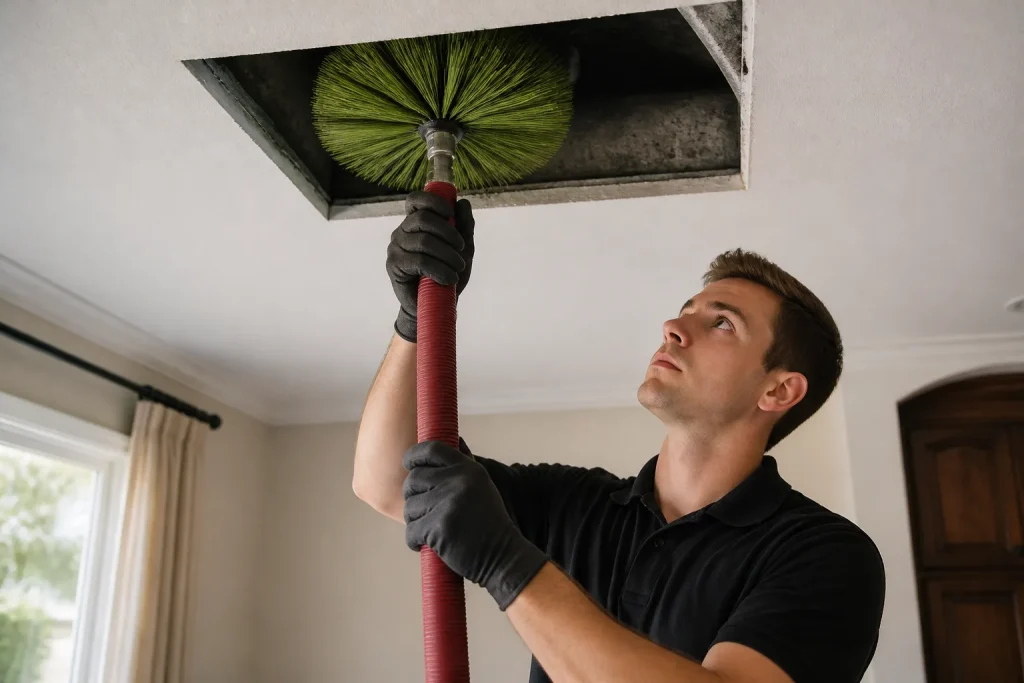
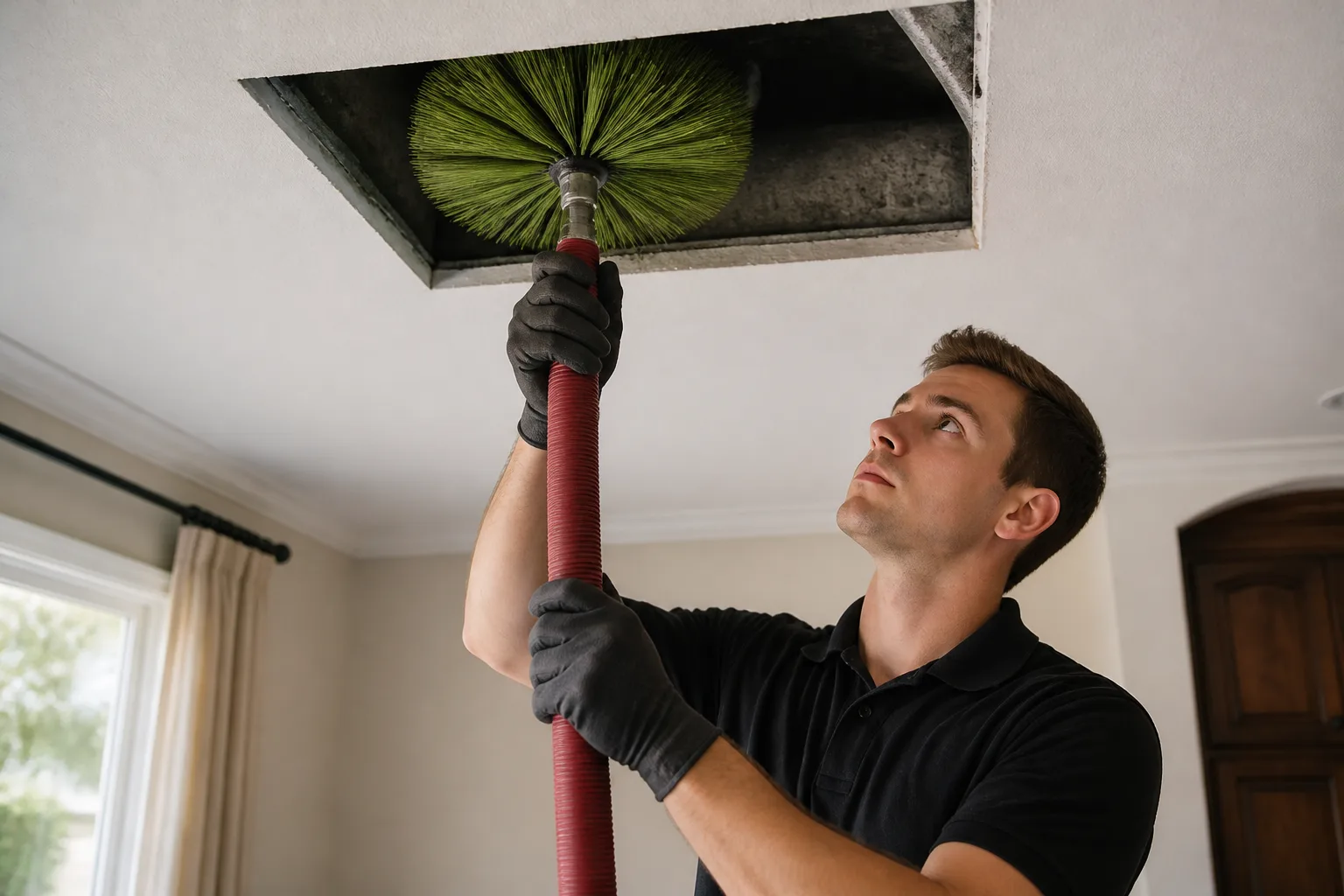
Rotobrush is a simultaneous agitation-and-containment system. A rotating brush head travels through the ductwork and loosens dust, debris and settled particulate from the walls, while a high-capacity vacuum running the whole time pulls that material out into a sealed collection system. The brush does the work; the vacuum makes sure the work doesn’t end up on your furniture.
That pairing is the part people miss when they compare quotes. A brush alone redistributes dust. A vacuum alone can’t break loose caked-on debris. Together they do both at once, and the continuous HEPA vacuuming during agitation is what keeps contamination contained rather than stirred into the air of your Aliso Viejo home.
What a technician controls matters as much as the machine:
- Brush size. Too large and it scrapes duct walls it shouldn’t touch. Too small and it skips the buildup.
- Rotation speed. Higher isn’t better. Speed gets matched to duct material and debris type.
- Line pressure and feed rate. How fast the head moves through a run changes how much it actually removes.
- Duct condition. A quick inspection of seams, joints and hangers before the brush goes in.
Owning a Rotobrush and knowing how to set it are two different skills. The variables above are what separate a trained operator from someone who bought the equipment and read the manual. Our technicians have up to 15 years of experience with professional-grade equipment, and we treat that setup step as the job, not the drive there.
Is Rotobrush Right for Your Aliso Viejo Home’s Ductwork?
Not always. That’s an honest answer you won’t hear from every company, but it’s the correct one. Rotobrush excels in rigid sheet metal ducts and in homes with medium-to-heavy settled debris. It requires caution in older flex duct, especially runs that are loosely supported or have already been compressed by attic heat and time.
Here’s how the fit usually breaks down for Aliso Viejo homes:
- Ideal: Rigid sheet metal trunk lines, heavier debris loads, ducts that have gone years without attention.
- Good with a careful operator: Well-supported flex runs in newer construction.
- Caution required: Aging flex duct, duct runs with weak hangers, or sections already showing sag or kinks.
The single biggest risk with flex duct is brush pressure. Push too hard and the brush can begin wearing micro-tears into the inner liner. Those tears don’t announce themselves. They show up later as air loss, more dust, and a repair bill that dwarfs what the cleaning cost. A knowledgeable technician inspects support spacing and duct condition first, then dials back the pressure. Professional-grade equipment, not shop-vac shortcuts, is only half the equation; the other half is knowing when to ease off.
Rotobrush vs. Negative-Air (Push-Pull) Cleaning: Which Fits Your Home?
For a typical 2,000 sq ft Aliso Viejo home with a mix of flex and rigid duct, the two methods usually land close in cost. The real differences are time, containment strategy, and what the ducts are built from. Rotobrush costs a bit more on average because it’s slower and labor-intensive. Negative-air push-pull, which uses a large vacuum and compressed air to drive debris toward a collection point, moves faster but relies on access and setup.
- Where Rotobrush wins: heavier debris, rigid metal ducts, and situations needing direct mechanical contact with the duct walls.
- Where push-pull wins: long flex runs, tighter access, and homes where aggressive brush contact isn’t advisable.
- Where they combine: many homes benefit from both methods on different parts of the same system.
Your home’s layout matters here. Aliso Viejo has plenty of hillside and canyon-adjacent neighborhoods where attic access varies block to block, and a method that works beautifully in one home can be a poor fit two streets over. Any company quoting you should be able to explain why they’re recommending one method over the other for your specific ductwork. If the answer is just “we use Rotobrush,” that’s a red flag. Clean ducts are the start; sealed, repaired ducts are the finish, and the method should serve that goal.
What Should Before-and-After Documentation Look Like?
Video inspection is the standard, and Rotobrush equipment is built to support it. Before cleaning, the technician should run a camera through your ductwork and show you what’s there. After cleaning, they should run it again, in the same spots, so you can compare. Anything short of that is a claim without proof.
Ask for:
- Pre-cleaning video of the main trunk and at least a few branch runs.
- Post-cleaning video from the same positions.
- Photos of the collection canister showing what came out.
- A written summary of what was cleaned and what was flagged for repair.
This matters more in this trade than almost any other, because duct cleaning has a reputation problem. The low-coupon-then-surprise-invoice model is real, and it’s why documentation should be standard. Measured air quality, not just a visual wipe-down, is what you’re paying for. If a company in Aliso Viejo can’t show you the inside of your own ducts before and after, keep looking.
When Should You Call a Pro Instead of Going It Alone?
Duct cleaning isn’t a homeowner task. Here’s when to stop researching and pick up the phone:
- You’ve noticed more dust settling on surfaces shortly after the HVAC runs.
- Someone in the house has allergies or asthma and symptoms track with the system running.
- You’ve had recent renovation or remodeling work that kicked up drywall dust.
- You can see visible debris, pests, or moisture inside a register with a flashlight.
- Your ductwork has never been cleaned and the home is more than a few years old.
We specialize exclusively in this work. Our scope is duct cleaning, dryer vent cleaning, HVAC cleaning, duct repair and sealing, and air quality sanitizing. That’s it. When you call about air duct cleaning in Aliso Viejo, the person who answers does this for a living, not as one line item among twenty.
Related services in Aliso Viejo: if your ducts and dryer vent are both due, the two are often handled in one visit.
For a full look at what we do and how we approach a home’s air system, see Aliso Viejo Air Duct Cleaning Pros. One team covers the entire air system, from duct cleaning to the sanitizing step that follows.
The Bottom Line
Rotobrush is a good tool. It’s not a magic one. The right choice depends on your duct material, your debris load, and the skill of the operator holding the machine. For rigid metal ducts with heavy buildup, Rotobrush earns its price. For older flex duct, negative-air cleaning is often the safer, smarter call, and a technician who knows the difference will tell you so before they quote you.
Two things to insist on regardless: a written estimate per job before work starts, never a per-vent price that can balloon, and video before and after. If you’re in Aliso Viejo and need help sorting out which method fits your home, Aliso Viejo Air Duct Cleaning Pros offers free estimates. Call (877) 820-9657. We answer 24/7. Fast dispatch from 7am to 7pm, Sunday through Friday.
Frequently Asked Questions
It’s better for some homes and not others. Rotobrush wins on rigid sheet metal ducts with heavy debris because its brush makes direct mechanical contact with the duct walls while the vacuum contains the dust. Negative-air push-pull is often better for long flex runs and tight attic access. The right answer depends on your specific ductwork, which is why a competent technician inspects first. Call (877) 820-9657 for an exact quote; estimates are free.
It can if the brush pressure is set incorrectly. Older flex duct with weak support is the main risk. Micro-tears in the inner liner can develop when the brush is pushed too hard or run too fast, and those tears lead to air loss and a repair bill. A trained operator inspects duct condition and support before choosing brush size and speed. If your ducts are aging flex, ask the technician how they’ll set the machine before they start.
Ask for video inspection before and after, from the same positions. Rotobrush equipment supports camera inspection, so any company using it can show you. Also ask for photos of what came out of the collection canister and a written summary of what was cleaned. If a company can’t show you the inside of your own ducts, that’s your answer. Call (877) 820-9657 and we’ll walk you through what the documentation should look like.
Usually because they’re based on a per-vent count or a teaser price that grows once the technician is on site. A per-vent quote doesn’t reflect the actual work of cleaning a whole system, and it leaves room for add-ons. One flat price per system, agreed before work starts, is the fair structure. If a quote seems too good, ask what it covers and whether the price is final. Call (877) 820-9657 for a flat-rate estimate; it’s free.
Written by the team at Aliso Viejo Air Duct Cleaning Pros.
Need Air Duct Cleaning Help?
Call Aliso Viejo Air Duct Cleaning Pros - the local pro we connect you with is licensed and insured, here with fast help in Aliso Viejo.
(877) 820-9657